Falls are the leading cause of injury for adults age 65 and older, and the bathroom is where the majority of home falls happen. Slippery surfaces, tight turns, low toilets, high tub walls, and cold hard floors combine to make a room most of us take for granted into the single most dangerous place in the house for an older loved one.
The good news: most bathroom fall risks can be reduced with a mix of simple habit changes, low-cost add-ons, and, when needed, targeted renovations. This guide walks through the bathroom zone by zone, identifies the specific hazards in each, and matches them to fixes that fit the budget and mobility level of the person using the room.
Why the Bathroom Is High-Risk for Older Adults
The bathroom combines the worst possible conditions for aging bodies: wet floors, hard surfaces, narrow spaces, and fixtures that require lowering into or climbing over. Balance issues, weaker leg strength, and slower reflexes all raise the risk. According to the CDC, about one in four adults 65 and older falls every year, and the bathroom is where most home falls happen.
Start With a Room-by-Room Safety Audit
Before installing a single grab bar, walk through the bathroom in the shoes of the person using it. Better yet, watch them use it, from the moment they approach the door to the moment they step back out. Notice where they reach, pause, or brace themselves. Those are your priority hazards. Small changes in the highest-risk spots deliver more safety than a scattered list of add-ons.
Below are the six zones every bathroom safety audit should cover, ordered roughly the way most people move through the space.
Zone 1: Getting To and Into the Bathroom
The path to the bathroom is a hazard zone in its own right. Nighttime is when most bathroom falls happen, and half the trip happens before the light goes on.
Hazards to fix
- Loose runner rugs or throw rugs in hallways.
- Dark or unlit path from bedroom to bathroom.
- High threshold at the bathroom door.
- Round doorknobs that are hard to grip with arthritic hands.
Solutions by cost
- Free/ behavioral: Move loose rugs out of the pathway; keep a clear line of sight from bed to bathroom door.
- Low-cost: Plug-in motion-activated night lights along the hallway and at the bathroom threshold.
- Remodel: Widen the doorway to at least 32 inches, replace round knobs with lever handles, and remove any threshold strip.
Zone 2: The Bathroom Floor
Wet feet, hard floor, low-friction surface. This is where balance fails without warning.
Hazards to fix
- Wet spots that do not get wiped up right away.
- Loose bath mats that slide when stepped on.
- Polished stone or high-gloss tile with low slip resistance.
- Clutter on the floor: laundry, hair-dryer cords, magazine racks.
Solutions by cost
- Free/behavioral: Wipe up water immediately; remove clutter; store cords off the floor.
- Low-cost: Replace loose mats with rubber-backed non-slip mats; apply anti-slip treatments to slick tile.
- Remodel: Re-tile with matte, textured, or coefficient-of-friction rated slip-resistant tile.
Zone 3: The Toilet Area
Getting up and down from a low toilet is one of the most physically demanding movements in an older adult’s day, and it happens multiple times daily.
Hazards to fix
- A standard-height toilet at 15 inches requires a deep knee bend.
- Nothing sturdy to grip nearby (a towel bar is not a grab bar).
- Toilet paper roll placed where it forces an awkward twist.
Solutions by cost
- Free/behavioral: Move the toilet paper holder within easy arm’s reach; keep a phone within reach for emergencies.
- Low-cost: Add a raised toilet seat with armrests; install a freestanding toilet safety frame.
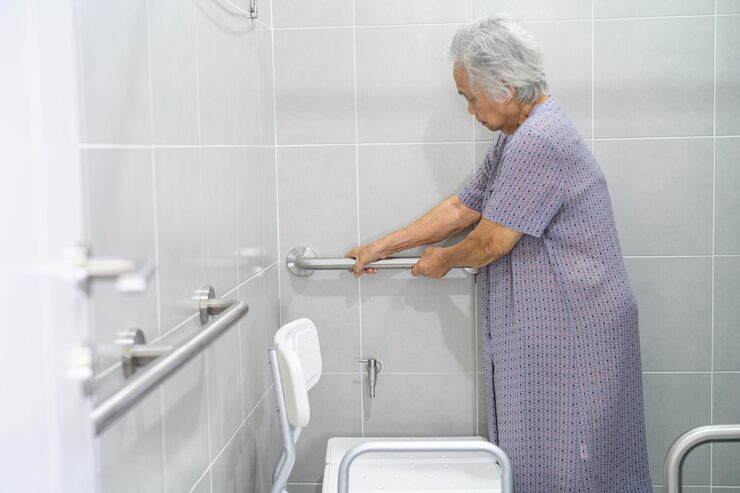
- Remodel: Replace with a comfort-height toilet (17 to 19 inches) and add wall-mounted grab bars at 33 to 36 inches on the strong-hand side wall.
Zone 4: The Sink and Vanity
Standing to brush teeth, wash a face, or shave requires balance and stamina that some older adults no longer have.
Hazards to fix
- Small twist knobs on faucets that are hard to grip with arthritis.
- Water temperature shifts too quickly and can scald.
- Nothing to lean on while standing at the sink.
- Reaching high or low into cabinets for daily items.
Solutions by cost
- Free / behavioral: move daily items (toothbrush, medications, hairbrush) to eye level; set the water heater to 120°F maximum.
- Low-cost: swap twist knobs for lever handles; add an anti-scald device at the faucet; keep a sturdy stool nearby.
- Remodel: install a wall-mounted vanity with open knee space beneath; use lever or touchless faucets; add a thermostatic mixing valve.
Zone 5: The Shower and Tub
This is the highest-risk zone in the bathroom. Wet skin, wet floor, eyes closed to rinse shampoo, and a bathtub wall to step over: the ingredients for a serious fall are all here.
Hazards to fix
- Stepping over a high tub wall.
- Slippery shower or tub floor.
- Nothing to grip while soaping or shampooing.
- Fixed showerhead that forces the user to stand up and turn under the water.
Solutions by cost
- Free/behavioral: Sit down to shower any time balance is a concern; keep the shower floor clear of bottles.
- Low-cost: Add a suction-cup non-slip mat; use a portable shower chair or tub transfer bench; add a handheld showerhead on a slide bar.
- Remodel: convert the tub to a curbless walk-in shower, install a built-in shower seat, and add permanent stud-anchored grab bars inside and outside the shower zone.
If the shower is used daily and the person has already had a fall or a close call, converting to a walk-in shower is often the single highest-value safety upgrade in the entire home.
Zone 6: Lighting and Visibility
Aging eyes need significantly more light than younger eyes to see contrast clearly. Poor lighting turns everything else on this list from a manageable risk into an accident.
Hazards to fix
- Single overhead light that leaves dark corners.
- Glare on wet, glossy tile that hides puddles.
- Light switch that requires reaching around a corner.
- No nighttime lighting.
Solutions by cost
- Free/behavioral: Turn lights on before entering; leave a small lamp or night light on overnight.
- Low-cost: Add motion-sensor night lights near the toilet and along the path; use warm-white LED bulbs to reduce glare on tile.
- Remodel: Add task lighting at the vanity, layered ambient lighting throughout, and rocker or motion-sensor switches at the entry.
Emergency Preparation – Plan for When Prevention Fails
Even the safest bathroom cannot eliminate the possibility of a fall. Planning for the moment after a fall is as important as preventing one.
- Keep a mobile phone within reach at the toilet and inside the shower zone (a waterproof pouch or wall-mounted speaker phone helps).
- Consider a medical alert pendant with automatic fall detection, water-rated for the shower.
- Make sure the bathroom door can be unlocked from the outside in case someone needs to reach the person inside.
- Post an emergency contact and the home address near the bathroom entrance for the person to reference if they need to call for help.
When to Move From Safety Fixes to a Remodel
Add-on products and behavioral changes have real limits. Consider a bathroom remodel focused on safety when any of the following are true:
- The person has already had one or more falls in the bathroom.
- Stepping over the tub wall has become the highest-anxiety part of the day.
- A walker or wheelchair is now in daily use, or is likely within the next few years.
- Grab bars cannot be added where needed because there are no studs in the right places.
- The floor plan itself creates the hazard (toilet crammed against a wall, no clear standing space near the shower).
A professional aging-in-place bathroom remodel with a curbless shower, comfort-height toilet, wide doorway, and slip-resistant flooring typically pays back in avoided injury, longer independence, and lower caregiver strain within a few years.
Final Thoughts
A safer bathroom is one of the highest-impact changes you can make in an older parent’s home. It lets them stay where they live, keeps a fall from becoming the event that changes everything, and reduces the daily anxiety that surrounds a room they use eight or ten times a day.
Start with the free changes today, add the low-cost hardware within the week, and when the layout itself is the limiting factor, talk to a remodeler who specializes in this work.